

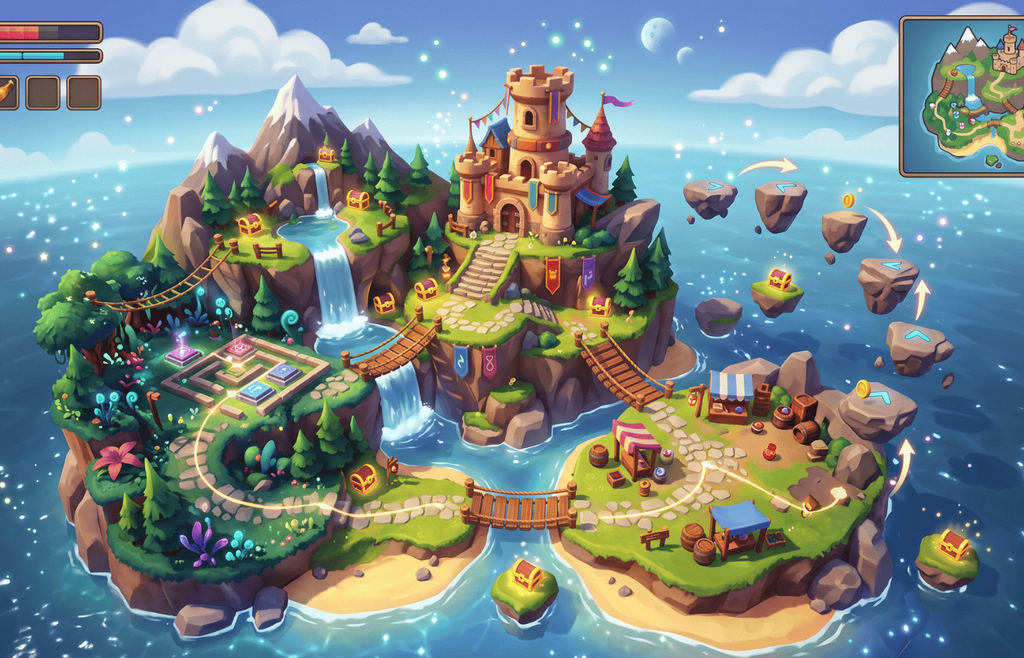
Imagine starting a game where the world was not completely planned by a human designer. The characters, challenges, locations, dialogue, and rewards may have been generated or adjusted by an artificial intelligence system.
At first, the experience could feel exciting. Every player might receive a slightly different adventure. An enemy could react to your habits. A character might remember your earlier decisions. A world could change based on how you play instead of following the same script for everyone.
But the same freedom could also create problems. The story may become confusing. The difficulty may feel unfair. Characters may repeat themselves or react in strange ways. A world with endless content might still feel empty if none of it has a meaningful purpose.
This is the future that AI games are beginning to explore. The important question is not whether AI can generate more content than a human team. It is whether that content creates a better experience for the player.
AI-designed does not always mean human-free
When people say that AI designed a game, they may be describing several very different situations.
AI could be used to:
- Suggest story ideas.
- Generate early concept art.
- Build test environments.
- Adjust enemy behaviour.
- Produce dialogue variations.
- Recommend difficulty settings.
- Create temporary assets.
- Generate quests during play.
- Adapt the game to individual players.
- Help developers test thousands of possible situations.
In most real projects, AI is more likely to work alongside human designers than replace them entirely. Humans still decide the purpose of the game, the target audience, the rules, the art direction, and the boundaries of the experience.
A game can use AI heavily and still be guided by human judgement. The difference depends on where the AI operates and how much control it has over the player-facing experience.
Three levels of AI involvement
AI-assisted development
At the first level, AI works behind the scenes. It may help with brainstorming, testing, code suggestions, animation support, or repetitive production tasks.
Players may never know that AI was involved because the final game behaves like a traditionally designed experience.
This approach can help development teams save time, but it does not necessarily change how the game feels.
AI-enhanced gameplay
At the second level, AI becomes visible during play. It may control a companion, adjust the difficulty, generate dialogue, or react to a player’s behaviour.
The main structure of the game remains designed in advance, but AI makes certain interactions more flexible.
This is similar to having a game system that can respond rather than simply follow a fixed list of commands.
AI-native gameplay
At the third level, AI becomes part of the central gameplay loop. The game may generate characters, quests, environments, or conversations while the player is playing.
If the AI system were removed, the main experience would change significantly.
A 2026 survey of AI-native game research described this distinction clearly. It separated games that use AI as a supporting tool from games where runtime generation is essential to the actual player experience.
This is the stage where games could become genuinely unpredictable.
What could become better?
More personalised worlds
A human designer usually creates one world for thousands or millions of players. AI could adjust parts of that world based on individual behaviour.
A cautious player might encounter more exploration opportunities. An aggressive player might face more combat-related challenges. Someone who spends time collecting objects could receive quests connected to that habit.
Personalisation can make a game feel more responsive because the player’s actions appear to matter beyond a single mission.
However, personalisation needs limits. If the game changes too much, players may lose the ability to compare experiences with friends or understand the wider story.
Characters that respond more naturally
Traditional characters often repeat the same lines after the player completes a task. AI could allow characters to respond to a wider range of questions and actions.
A companion might:
- Comment on your recent decisions.
- Suggest a different strategy.
- Remember a previous conversation.
- React to your success or failure.
- Offer information in a different way.
- Develop a personality based on repeated interactions.
This could make Online Games feel more alive, especially when characters are designed to help, challenge, or accompany the player.
The quality of the interaction would depend on context. A character that can speak endlessly but says nothing useful may become more annoying than a character with ten carefully written lines.
More varied missions
AI could produce variations of a familiar objective. Instead of repeating the exact same mission, players might receive different locations, obstacles, rules, or rewards.
This could extend replay value without requiring every variation to be manually designed.
The risk is that variety can become meaningless. A different mission is not automatically a better mission. The goal, stakes, and reward still need to make sense.
Adaptive difficulty
AI could observe how a player performs and adjust the challenge accordingly. Someone struggling with the controls might receive more time or clearer guidance. A skilled player might encounter faster enemies, fewer resources, or more complex objectives.
This could make games more welcoming to players with different experience levels.
But adaptive difficulty must remain transparent enough to feel fair. If players do not understand why the game suddenly became easier or harder, they may feel manipulated.
Why AI-designed worlds could become weird
The word “weird” is not always negative. Unexpected results can create the most memorable moments in a game.
An AI system may combine familiar elements in a way a human designer would not have considered. It might produce an unusual character relationship, a strange quest, or a surprising environmental change.
The player may discover:
- A character interpreting a command too literally.
- A mission that changes because of an earlier decision.
- A location that develops a different purpose.
- A companion that reacts unexpectedly.
- A challenge that combines unrelated mechanics.
- A story branch that feels personal to a specific play style.
This kind of weirdness can make a game feel alive. It gives players stories to share because their experience may not be identical to anyone else’s.
But strange results need to remain connected to the game’s rules. If the AI generates events without considering the story, objectives, or difficulty, the experience can quickly become confusing.
The biggest problem is coherence
A human designer can think about the entire game as one connected experience. They can decide how the opening prepares the player for the ending, how the art supports the story, and how each reward fits the larger objective.
An AI may generate individual pieces that look interesting but do not work well together.
This can lead to:
- Characters who contradict earlier dialogue.
- Rewards that have no real purpose.
- Missions that do not match the player’s abilities.
- Difficulty spikes without warning.
- Locations that feel disconnected.
- Stories that lose their emotional direction.
- Endless content with little meaning.
More content is not the same as more value. Players do not need infinite quests if most of them feel interchangeable.
The strongest AI systems will need human-designed structure around them. Goals, rules, pacing, feedback, and player agency must remain stable even when the details change.
A 2026 study on contextual generative AI found that generated items and adaptive NPC dialogue improved player experience when they were connected to the game’s mechanics and context. The finding is important because it suggests that AI works best when it is guided by the rules of the game rather than added as a disconnected novelty.
A browser sandbox where the player stays in charge
On Astrocade, Ultra Realistic Minecraft is a 3D open-world voxel sandbox inspired by Minecraft, with a more realistic visual direction. Players gather resources, craft items, and survive against enemies in survival mode, or switch to creative mode to build freely with a wide range of blocks. The experience gives players control over how they want to play, whether they prefer gathering and survival or open-ended construction. It runs directly in the browser with no download needed, making it accessible for players who want to start quickly. The supplied summary describes a sandbox with defined survival and creative systems, but it does not confirm that AI designed its world, characters, or mechanics. The game should therefore be presented as a browser-based voxel sandbox, not as an AI-generated game.
