

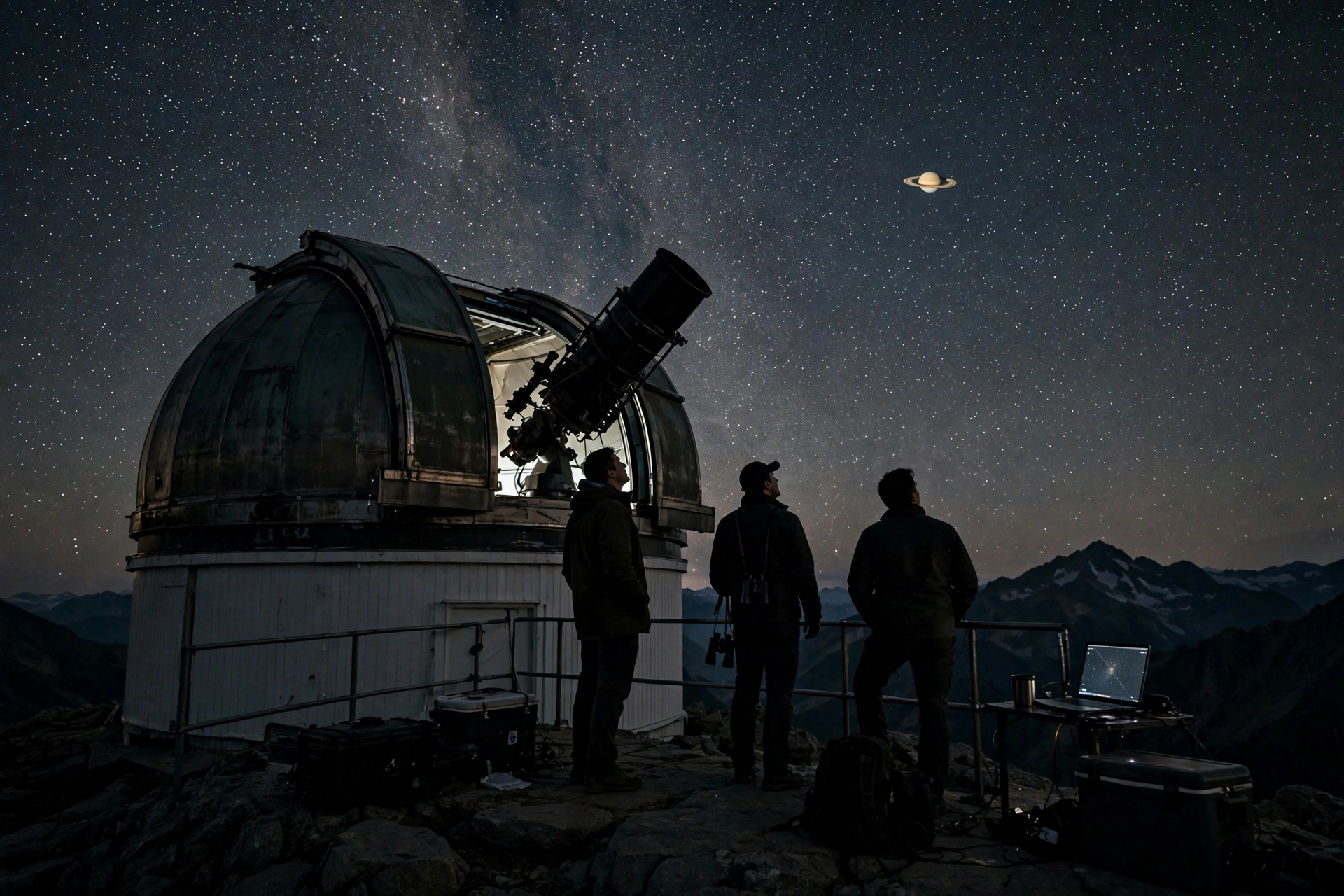
If you learned the planets from a classroom poster, it may be time to update the caption under Saturn. Astronomers have confirmed 128 more moons in orbit around the ringed giant, bringing its recognised total to 274 — comfortably the highest of any planet in the solar system. The announcement sounds sudden, but it rests on years of unglamorous work: photographing the same patch of sky, again and again, until faint dots proved they belonged to Saturn.
The observations came from the Canada-France-Hawaii Telescope, perched on Mauna Kea, and involved researchers at the University of British Columbia among others. Their candidate moons were checked over multiple seasons before the International Astronomical Union recognised them, which is the formal step that turns a suspected speck into a counted moon.
From faint speck to confirmed moon
A single image can show thousands of dots, most of them distant stars or galaxies. A moon betrays itself by moving with Saturn between exposures and returning to a predictable position months later. Teams therefore stack many images to make dim objects stand out, then calculate a full orbit from sightings spread across years. Anything that cannot be tracked reliably stays off the official list, no matter how promising it first looked.
That slow verification is why the total jumped in one announcement rather than creeping up moon by moon. It is a familiar pattern in space news, where patience behind the scenes contrasts with spectacle in the sky — much like the patient explaining behind our explainer on the jellyfish-like cloud seen after a recent rocket launch.
Captured wanderers and broken worlds
Do not picture 274 neat, round worlds. The new arrivals are tiny irregular moons, many only a few kilometres across, travelling on wide, tilted orbits — some in the opposite direction to Saturn’s spin. Astronomers think most are captured objects or pieces of captured objects: asteroids or comet-like bodies pulled in by Saturn’s gravity, then ground down by collisions into clusters of related fragments.
Those clusters are scientifically precious. Moons that share an orbital family almost certainly share an origin, so mapping the families reconstructs a history of impacts around Saturn. Background on the survey team and its earlier moon work is available from the University of British Columbia, which has helped lead the census of the outer planets’ smaller moons.
Why an ordinary reader should care
Beyond the record itself, the census matters because moons are evidence. Their numbers, sizes and orbits test computer models of how the solar system formed and settled. If models predict far fewer captured fragments than telescopes actually find, the models — not the telescopes — need revising. Each confirmed moon is therefore a small vote for a more violent, collision-filled early solar system than textbooks once described.
There is a consumer angle too: better catalogues of small bodies help mission planners and skywatchers alike. Future probes heading to the outer planets navigate a neighbourhood that is now measurably more crowded than we thought, and knowing what is out there, and where, is basic safety information as much as pure science.
Could the total climb again?
Very probably. Every generation of more sensitive telescopes has found moons the previous generation missed, and there is no reason to think the current instruments have reached the bottom of Saturn’s retinue. The official count will also occasionally need tidying, as better data refines orbits. But the headline is stable for now: at 274 recognised moons, Saturn holds a record that reflects both its enormous gravity and astronomers’ growing ability to find the faintest members of its household — worlds so small they hid in plain sight until someone thought to look, carefully, for years.
There is one more detail worth keeping from the announcement: the moons were not all found in a single observing run, and they were not all found recently. Some candidates waited years in the archive while astronomers gathered the extra sightings needed to be sure. That long tail of verification work rarely makes headlines, yet it is the difference between a rumour of a moon and a moon the whole world can count. When the next update arrives — and astronomers quietly expect one — it will have been earned the same slow way, one confirmed orbit at a time.
