

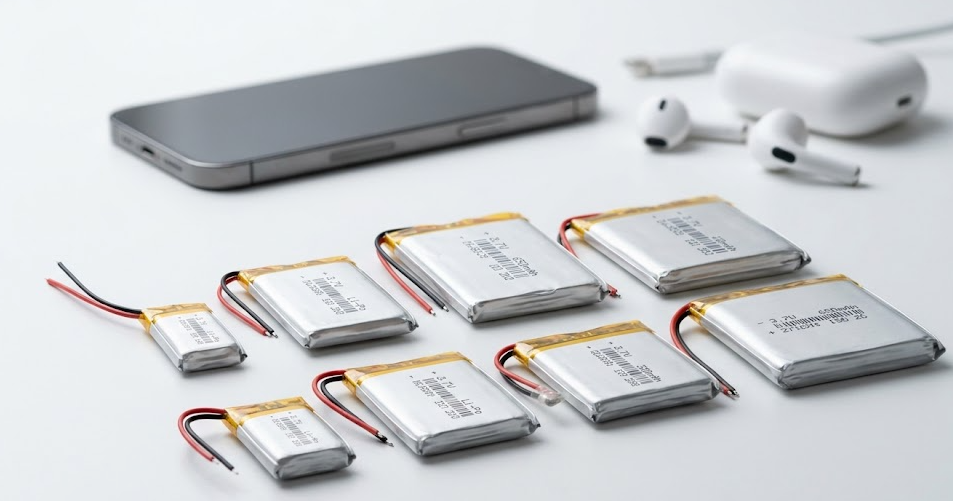
A 3.7V polymer battery is a rechargeable lithium cell that uses a polymer electrolyte instead of a liquid one, housed in a lightweight, flexible pouch rather than a rigid metal casing. That combination of high energy density, thin profile, and design flexibility has made it one of the most widely used battery formats in modern electronics — from smartphones and earbuds to drones and medical wearables.
What Is a 3.7V Polymer Battery?
The 3.7V refers to the cell’s nominal voltage — the average output it delivers through most of its discharge cycle. Fully charged, a lithium polymer cell reaches around 4.2V; at the end of its discharge, the voltage drops to roughly 3.0V. The 3.7V figure represents the midpoint that manufacturers use as a standard reference.
Polymer refers to the electrolyte. Traditional lithium-ion cells use a liquid electrolyte inside a metal cylinder. In a polymer battery, manufacturers replace that liquid with a gel or solid polymer material, which allows the cell to be sealed in a thin, flexible pouch and shaped to fit almost any form factor.
How the Polymer Format Works
During discharge, lithium ions move from the anode through the polymer electrolyte to the cathode, generating an electric current. During charging, that process reverses. The polymer electrolyte conducts ions between electrodes while also acting as a separator — eliminating the need for a rigid outer casing to contain a liquid.
This design gives engineers far more freedom than cylindrical or prismatic cells. Manufacturers can produce 3.7V polymer battery in thin rectangular sheets, curved formats, or custom shapes that fit precisely within a device’s available space.
Key Advantages Over Rigid Cell Formats
- Lightweight — The pouch packaging weighs significantly less than a steel or aluminum cylinder of equivalent capacity.
- Thin and flexible — Cells can be manufactured as thin as 1–2mm, enabling ultra-slim device designs.
- High energy density — More usable energy per gram compared to older nickel-based chemistries.
- Custom sizing — Manufacturers can produce cells in virtually any dimensions to match a specific device layout.
- Low self-discharge — Polymer cells retain charge well during storage, typically losing around 2–3% per month.
Where 3.7V Polymer Batteries Are Used
The slim profile and flexible form factor make these cells a natural fit across a wide range of applications:
- Smartphones and tablets — The dominant power source for handheld consumer devices worldwide.
- Wireless earbuds and audio devices — Compact cells fit the small, irregular spaces inside earbud housings.
- Drones and RC aircraft — High discharge rate variants (rated in C) power the motors in lightweight unmanned vehicles.
- Smartwatches and fitness trackers — Thin, curved cells fit within wearable form factors without adding bulk.
- IoT and connected devices — Low-power sensor nodes and tracking devices benefit from the format’s size flexibility.
- Portable medical equipment — Lightweight construction suits body-worn monitors and handheld diagnostic tools.
What to Consider When Selecting One
Choosing the right 3.7V polymer battery for a design involves more than matching the voltage:
- Capacity (mAh) — Determines runtime at a given current draw. Higher capacity typically means a larger or heavier cell.
- Discharge rate (C rating) — Applications with high peak current demands, such as drones, need cells with a high continuous discharge rating.
- Protection circuit (PCM) — Most applications require a built-in protection circuit to prevent overcharge, over-discharge, and short circuit events.
- Physical dimensions — Confirm the cell fits within the available space, including thickness tolerance.
- Cycle life — Standard polymer cells typically support 300–500 full charge cycles before capacity degrades noticeably.
Reviewing verified test data from established 3.7V polymer battery manufacturers is the most reliable way to confirm performance claims before committing to a design.
A Flexible Power Source for Modern Devices
The 3.7V polymer battery succeeds because it fits where other formats can’t — physically and technically. Its lightweight construction, shape flexibility, and solid energy density make it the default choice for compact, portable, and wearable electronics. Designers who understand its characteristics and limitations can make faster, better-informed decisions early in the product development process.
