

Adults with type 2 diabetes who do not use insulin could gain roughly five extra hours a day in their target blood sugar range by wearing a continuous glucose monitor, according to the largest clinical trial of its kind, published in the New England Journal of Medicine. The finding matters because continuous glucose monitors, long associated mainly with insulin users, have often been viewed as unnecessary for the much larger group of people who manage type 2 diabetes with tablets, diet and activity alone. The new evidence challenges that assumption and suggests the small wearable sensors can change day-to-day decisions in ways that quickly add up.
What the trial actually found
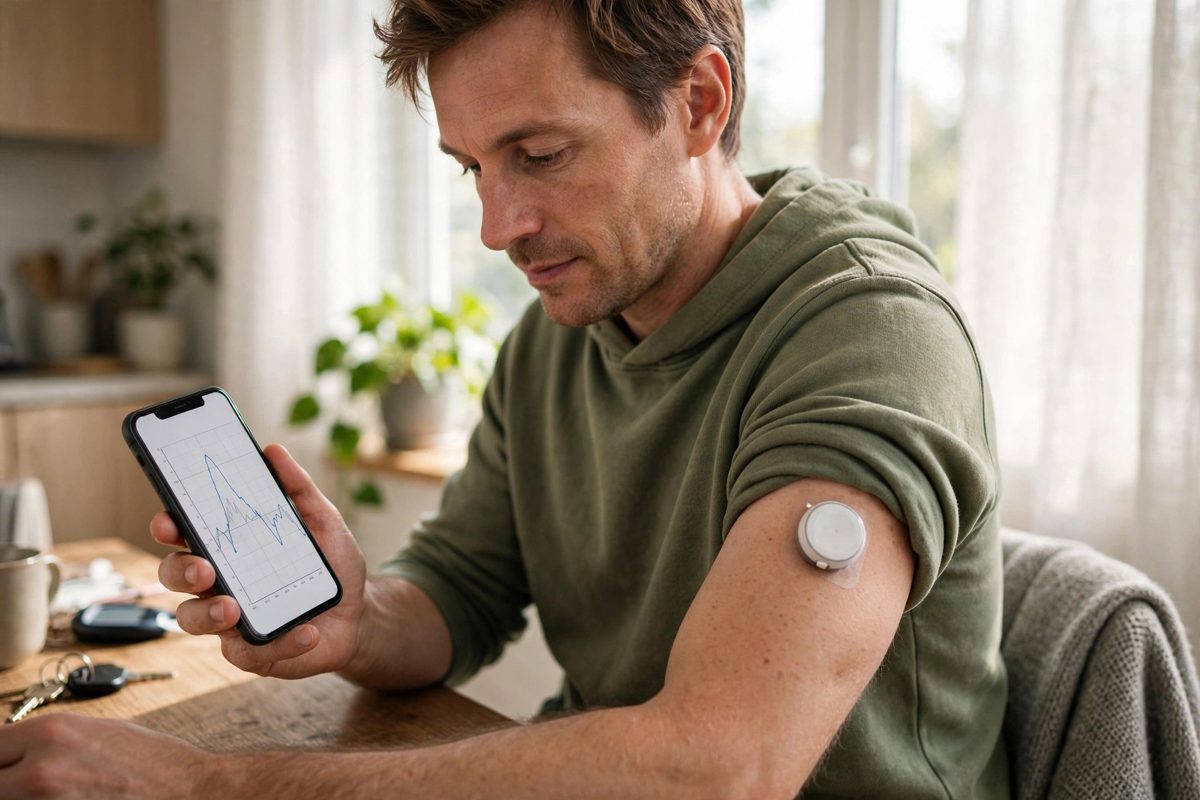
Continuous glucose monitors are small sensors, usually worn on the upper arm or abdomen, that measure glucose in the fluid under the skin every few minutes and send the readings to a phone or receiver. Instead of a handful of finger-prick tests, users get a near-continuous picture, complete with trend arrows showing whether levels are rising, falling or holding steady. In the trial, that visibility translated into about five more hours each day spent inside the target range that clinicians associate with a lower risk of long-term complications. Researchers describe time in range as a practical measure because it captures stability, not just an average.
The scale of the study is part of its significance. Smaller projects had hinted at similar benefits, but a large, carefully controlled trial gives doctors, insurers and guideline committees firmer ground to stand on. It also speaks to a group that is frequently overlooked in diabetes technology research: adults whose condition is serious enough to need daily attention, but who do not inject insulin and may have been told, implicitly or directly, that advanced monitoring tools are not meant for them.
Why five hours is a big deal
Blood sugar that spends long periods above target quietly raises the risk of damage to eyes, kidneys, nerves and blood vessels over time. Five additional hours a day in range works out to roughly thirty-five hours a week, week after week, which is why specialists treat it as clinically meaningful rather than a statistical curiosity. Just as importantly, the benefit appears to come from behaviour as much as from technology. Seeing a spike after a particular meal, a walk after dinner flattening a curve, or a poor night of sleep showing up the next morning turns abstract advice into personal, immediate feedback.
That learning loop is familiar to readers who follow how professionals present their expertise in our coverage of presenting mental health qualifications professionally: clear information, presented at the right moment, helps people make better decisions. Glucose data works in much the same way, only the audience is the patient and the feedback arrives within minutes.
Who could benefit, and what are the limits?
The results do not mean every person with type 2 diabetes needs a sensor tomorrow. The devices cost money, supplies must be replaced regularly, and some people find constant data stressful rather than empowering. Skin irritation, alarm fatigue and the simple burden of another medical device are real considerations. Coverage also varies widely, and, as our recent reporting on hidden fees quietly costing shoppers showed in another context, the headline price of a health product is rarely the whole story once replacements and accessories are counted.
Doctors are therefore likely to target the technology first at patients whose blood sugar remains above goal despite standard care, or whose levels swing unpredictably. The American Diabetes Association provides general guidance on monitoring options, and specialists stress that a conversation about goals, budget and comfort with technology should come before any prescription. A monitor also only measures; it does not treat. Food, movement, medication and sleep still do the heavy lifting.
A shift in how diabetes care is organised
If guidelines and insurance coverage follow the evidence, clinics may need to rethink who gets offered monitoring and how the resulting data is reviewed. A sensor generates far more information than a quarterly lab test, and somebody has to help patients interpret it without turning every fluctuation into an emergency. Pharmacists, diabetes educators and primary care teams could all play a larger role, particularly for people newly diagnosed who are still building routines.
For now, the headline is simple. A major trial has shown that a tool once reserved for a narrower group can deliver a meaningful, measurable improvement for adults with type 2 diabetes who do not use insulin. About five extra hours a day in a healthier range is a benefit patients can understand instantly, and it may reshape what standard diabetes care looks like in the years ahead.
