

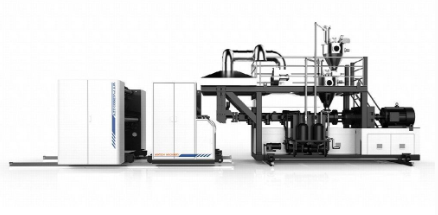
Cling film is widely used in food packaging, commercial kitchens, supermarkets, and household storage. Although finished films may look similar at first glance, their manufacturing requirements can vary considerably depending on the polymer, intended application, and desired film properties.
For manufacturers, selecting production equipment is therefore not simply a matter of comparing machine speeds or output capacity. The material being processed must be considered alongside film thickness, width, winding requirements, and the conditions under which the finished product will be used.
Understanding these relationships helps manufacturers make more informed decisions when planning a new production line or upgrading existing equipment.
PVC and PE: Different Materials, Different Requirements
Polyvinyl chloride (PVC) and polyethylene (PE) are both used in flexible film applications, but they have different material characteristics and processing requirements.
PVC cling film has traditionally been used in certain food-wrapping applications because suitable formulations can provide good cling properties and transparency. However, PVC processing requires careful temperature management, and manufacturers must use appropriate formulations and operating procedures.
PE-based films offer a different set of characteristics. Depending on the grade and film structure, polyethylene can provide flexibility, moisture resistance, and suitability for various packaging applications. The exact performance depends on the material formulation and the intended use.
These differences matter when manufacturers plan their production processes. A line configured for one material should not automatically be assumed suitable for another without checking the equipment design, temperature requirements, processing conditions, and product specifications.
Material selection should begin with the finished film’s intended purpose rather than the machine itself. Once the target application is clear, manufacturers can determine which material and processing configuration are appropriate.
Why the Production Line Must Match the Film Specification
A cling film production line needs to deliver film that meets defined requirements for thickness, width, appearance, and winding quality. These requirements should be established before equipment is selected.
For example, a manufacturer producing several film widths may need a configuration that accommodates different product specifications and changeover requirements. A business focused on a narrower product range may place greater emphasis on repeatability and straightforward operation.
Film thickness is another important consideration. Uneven thickness can affect the finished roll’s appearance and practical performance. Maintaining consistency requires attention to the processing conditions, material characteristics, and the capabilities of the production line.
Manufacturers should also consider the intended roll format. Household retail rolls, commercial packaging rolls, and other formats may require different winding arrangements or downstream handling procedures.
A useful equipment assessment therefore starts with a list of actual production requirements, including:
- The material or materials to be processed.
- The required film width and thickness range.
- The expected product formats and roll dimensions.
- The consistency requirements for the finished film.
- The planned production volume and frequency of product changes.
These details provide a more reliable basis for evaluating equipment than headline specifications alone.
Temperature Management and Process Stability
Temperature management is particularly important in polymer film production because material behavior changes with processing conditions.
For PVC, the operating window must be controlled carefully to avoid unsuitable processing conditions. For PE, temperature settings must also be matched to the grade and the requirements of the intended film. In both cases, inappropriate settings can affect processing stability and finished-film quality.
Manufacturers should not rely on a single temperature setting as a universal solution. Appropriate conditions depend on the material formulation, equipment configuration, production targets, and recommendations from the material supplier and machinery manufacturer.
Stable operation also depends on monitoring the process over time. When film quality changes, operators should examine relevant factors systematically instead of adjusting several settings at once. Material variation, temperature changes, inconsistent feeding, and downstream handling may all warrant investigation.
A documented operating procedure can help production teams repeat successful settings and identify deviations more quickly. This becomes especially valuable when several operators share responsibility for the same production line.
The Role of Winding in Finished-Roll Quality
Film quality is not determined entirely during extrusion or film formation. Winding is another important stage because it affects how the finished material is collected and presented.
If winding tension is unsuitable, rolls may develop uneven edges, loose sections, wrinkles, or other defects. The exact outcome depends on the film properties, roll dimensions, and winding system.
As the roll diameter increases, the winding conditions may need to change to maintain appropriate tension. A system that manages these changes effectively can help produce more consistent rolls, provided the upstream film quality is also stable.
Manufacturers should evaluate winding requirements when planning the complete production line. Questions worth asking include whether the line needs automatic roll handling, whether different roll sizes will be produced, and how frequently operators will need to change products.
For businesses selling film in multiple formats, changeover procedures can be particularly important. Equipment that accommodates the required roll specifications without unnecessarily complicated adjustments may make day-to-day production easier to manage.
What to Evaluate When Choosing a PVC Cling Film Machine
Choosing a machine begins with confirming that its intended configuration is suitable for the required material and finished product. Manufacturers should request clear technical information rather than relying only on general descriptions.
A PVC cling film machine should be evaluated against the actual production plan, including material compatibility, film specifications, process controls, winding arrangements, and maintenance requirements.
Several questions can help structure the evaluation.
Is the machine suitable for the intended material?
Confirm the supported polymer, applicable formulation requirements, and recommended processing conditions. If the production plan includes more than one material, ask the manufacturer to explain what configuration changes or additional components may be necessary.
Can it produce the required film dimensions?
Check the specified film width and thickness range, as well as the expected finished-roll dimensions. Confirm that the stated capabilities match the products the business intends to manufacture.
How are operating conditions monitored?
Review the available temperature controls, operating displays, adjustment methods, and relevant process-monitoring features. The objective is to understand how operators will maintain consistent conditions during normal production.
What maintenance will be required?
Ask about routine inspections, consumable components, cleaning procedures, spare parts, and service access. These considerations affect the practical demands of operating the line over time.
How are product changes handled?
If the business expects to produce multiple roll sizes or film specifications, examine the changeover procedure. A configuration that suits one standard product may not be the most convenient choice for a varied production schedule.
The answers should be assessed together. A machine’s advertised capacity has limited value if its configuration does not match the material, product dimensions, or operating requirements of the business.
Planning for Consistent Production Over Time
Equipment selection is only one part of a reliable manufacturing operation. Material consistency, operator training, maintenance, and quality checks also contribute to repeatable results.
Manufacturers can establish inspection procedures for film appearance, dimensions, winding quality, and other product-specific requirements. Recording production conditions and recurring defects can help teams identify patterns and investigate problems more systematically.
Material suppliers should also be consulted when manufacturers change polymer grades or formulations. A material change can affect processing behavior, so the operating procedure may need to be reviewed before production resumes.
For businesses planning future expansion, it is worth considering whether the initial equipment configuration can accommodate realistic changes in product range or production volume. This does not necessarily mean purchasing the largest available system. It means understanding which future requirements are likely and whether the proposed configuration can support them.
Conclusion
Material selection influences nearly every major decision involved in cling film manufacturing, from processing conditions to film specifications and winding arrangements. PVC and PE should not be treated as interchangeable materials, and production equipment should be assessed according to the requirements of the intended product.
By defining material compatibility, film dimensions, process controls, roll formats, and maintenance needs before purchasing equipment, manufacturers can make better-informed decisions and establish more consistent production procedures.
The most suitable production line is not simply the one with the highest advertised output. It is the one whose configuration, operating requirements, and capabilities match the manufacturer’s materials and finished-film specifications.
