

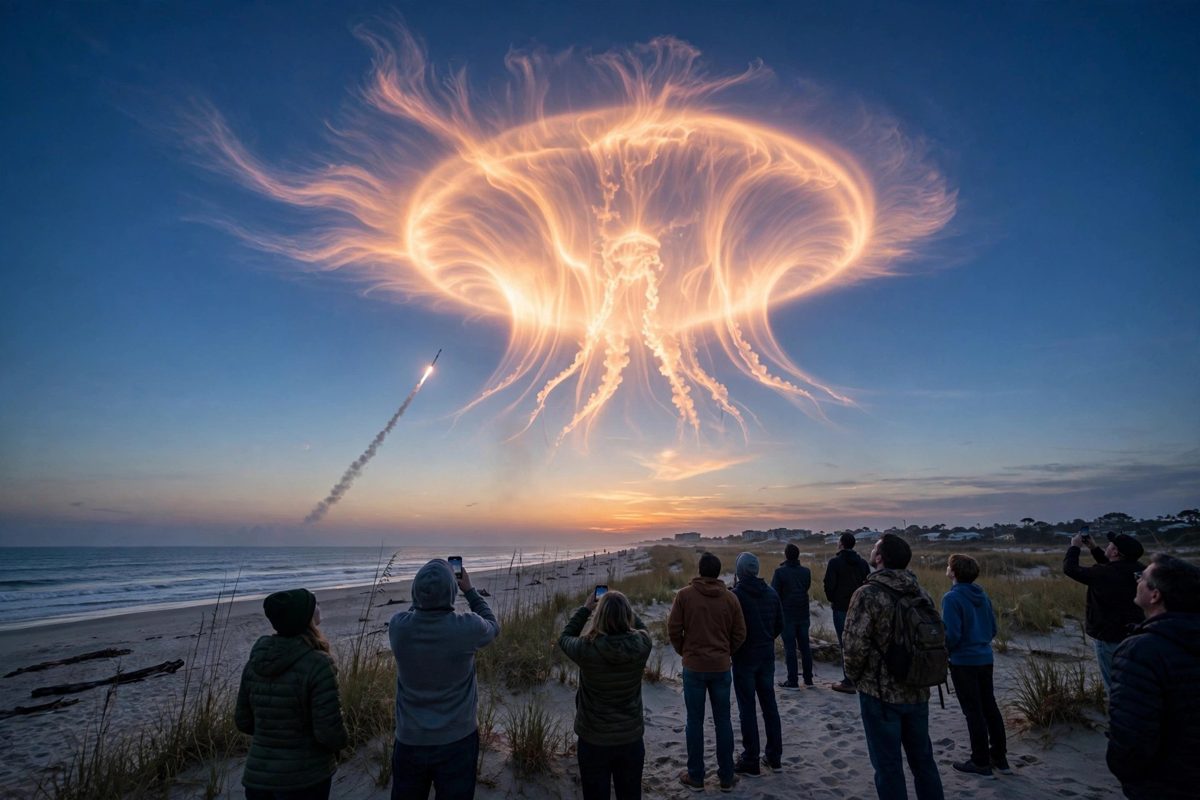
Skywatchers along the United States east coast were treated to an unusual dawn spectacle this week when a SpaceX rocket launch produced a glowing, jellyfish-shaped cloud high in the atmosphere, visible across a wide stretch of the coastline. Photographs shared from beaches, rooftops and back gardens showed a bright plume fanning out against the dark early-morning sky, its translucent tendrils curling in a way that has earned the phenomenon its nickname among space enthusiasts: the space jellyfish. The Guardian’s report on the jellyfish cloud collected images from witnesses who watched the display unfold in near silence.
What creates a space jellyfish?
The effect is a trick of timing and altitude. When a rocket launches shortly before sunrise or just after sunset, the ground below is still in darkness while the exhaust plume, tens of kilometres up, catches direct sunlight. The expanding gases from the engine glow against the dark sky and spread into a wide, luminous fan as the vehicle climbs through thinner air. From the ground, the brightest part forms the bell of the jellyfish, while drifting exhaust and vapour trail behind like tentacles. The display can last several minutes before the plume disperses and fades.
Because the cloud sits so high, it can be seen from hundreds of kilometres away, which is why reports and photographs arrive from an entire coastline rather than a single town. Weather matters too: clear skies at ground level and calm conditions aloft keep the shape crisp instead of smeared, and this week’s conditions appear to have been close to ideal.
Why launches keep drawing crowds
SpaceX launches have become public events in their own right. The company’s busy schedule, published through its official SpaceX website, means residents near launch corridors increasingly plan early mornings and evenings around liftoff times, and a jellyfish display adds a bonus that even people with no interest in spaceflight stop to watch. Local photographers say the pre-dawn launches are the most rewarding and the most unforgiving: the window is short, the light changes quickly, and there is no second take.
There is a practical side to the crowds as well. Tourism businesses near launch viewing areas report busier car parks and cafes on launch mornings, a pattern our business readers will recognise from coverage of how smaller firms find new buyers: a reliable draw, repeated often enough, becomes part of the local economy. Not every visitor spends money, of course, and residents can find road closures tiresome, but a spectacular sky tends to soften complaints.
Not a UFO, and not a cause for alarm
Every jellyfish sighting triggers the same brief wave of confusion. A glowing, silent, unfamiliar shape at dawn invites speculation, and emergency services and newsrooms routinely field calls until the launch connection is confirmed. Scientists are quick to reassure: the cloud is rocket exhaust lit by the sun, its behaviour is well understood, and the phenomenon has been documented for decades, long before social media made each occurrence famous within the hour. Similar effects have followed launches in several countries and are studied as part of how high-altitude plumes interact with the upper atmosphere.
That instant documentation is part of the story in itself. A display that once would have lived on as a local anecdote is now photographed from dozens of locations, stitched into timelines and compared with previous launches before breakfast, much like the everyday technology habits we explored in building a personal gaming routine, where phones quietly organise how people spend their leisure time.
How to catch the next one
The recipe is straightforward. Look for a launch scheduled in the hour or so before sunrise or after sunset, pick an open spot with a clear view towards the launch site, and arrive early enough for your eyes to adjust to the dark. The brightest phase comes a few minutes after liftoff, once the vehicle is high enough for its plume to catch the sun. Binoculars help pick out structure in the cloud, but they are not essential; the best seat, as hundreds of east coast residents proved this week, is simply outside, looking up at the right moment.
With launch schedules as busy as they now are, the next jellyfish is probably a matter of weeks rather than years. For the people who saw this one, though, it will be hard to beat: a silent, glowing creature of light and exhaust, hanging over the coast at dawn, and a reminder that some of the best shows in the sky are made by human hands.
