

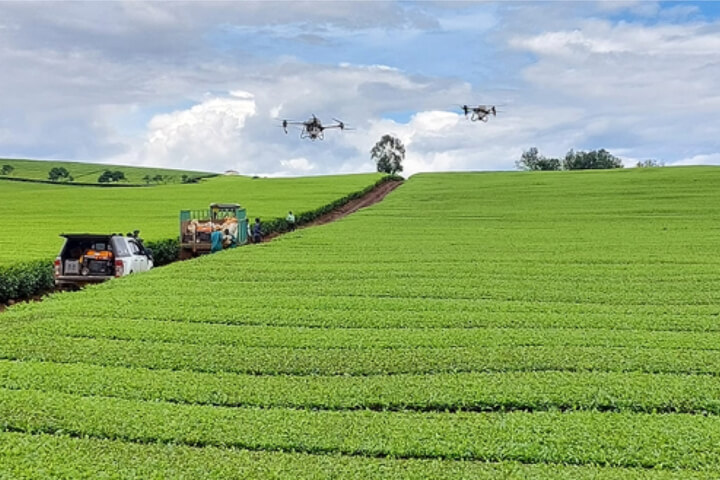
Tea cultivation depends on precision at every stage. From monitoring plant health and managing pest pressure to maintaining leaf quality and ensuring timely spraying, plantation management requires constant attention to detail. In a crop system where even small delays or uneven application can affect both yield and quality, efficient field operations matter greatly.
This is why agricultural drones are becoming increasingly relevant in plantation agriculture. A recent study by BlueWeave Consulting forecasts that the India agriculture drones market will witness a four-fold increase by 2028, growing at a CAGR of more than 25% between 2022 and 2028.
This is where agricultural drones for tea plantations are gaining importance. By helping plantation managers improve field coverage, spray accuracy, and operational efficiency, drones are offering a smarter way to handle crop protection and plantation care across large and varied tea-growing areas.
Why Tea Plantations Need Smarter Spraying Solutions
Tea plantations present a very different operational environment from many other crop systems. They often include uneven terrain, varying moisture conditions, and zone-specific crop health challenges. Managing these plantations with conventional spraying methods can be difficult, especially when consistency and timing are critical.
Traditional spraying may involve slower coverage, higher labour dependence, and uneven application across different parts of the plantation.
In tea cultivation, where crop care has a direct effect on plant health and leaf quality, these limitations can become costly over time. This is why plantation managers are increasingly looking for more accurate and scalable spraying solutions.
What Agricultural Drones Mean for Tea Plantations
Agricultural drones are giving tea plantations a more efficient and accurate way to manage crop care across large and often uneven growing areas. In tea cultivation, where plantation blocks can differ in slope, moisture, plant condition, and spray requirements, drones help make operations more practical by improving how spraying and monitoring are carried out.
What this means in practice:
- Better coverage across plantation zones: Drones help spray large and uneven tea-growing areas more efficiently than many conventional methods.
- Improved spray accuracy: They support more controlled application, which helps reduce patchy treatment, overlap, and missed sections.
- Faster response during critical crop care stages: Plantation managers can act more quickly when spraying or monitoring needs to happen on time.
- Less dependence on labour-heavy spraying methods: Drones reduce the operational burden of manual application across large estates.
- More efficient plantation management: They help make crop protection and field operations more organized, timely, and easier to scale.
- Stronger fit for modern tea cultivation: In a crop system where quality, consistency, and timing matter, drones offer a more practical and technology-led approach to plantation care.
These advantages show how agricultural drones are helping tea plantations improve coverage, accuracy, and overall operational efficiency.
How Agricultural Drones Improve Spray Accuracy
Coverage alone is not enough in tea cultivation. Accuracy also matters because uneven spraying can lead to under-treatment in some sections and unnecessary overlap in others. Agricultural drones improve this by making spray application more controlled and consistent across plantation zones.
How they improve accuracy:
- Support more uniform application: Drones help reduce patchy spraying and improve treatment consistency.
- Reduce overlap and missed areas: Guided spraying paths make it easier to manage crop protection more precisely.
- Improve input targeting: Plantation managers can use crop protection inputs more carefully based on operational need.
- Strengthen overall spray quality: Better accuracy helps improve the effectiveness of plantation care and crop protection practices.
This makes agricultural drones a strong fit for tea estates where both field coverage and spray precision directly affect plantation performance.
Practical Benefits for Tea Plantation Management
Agricultural drones offer more than just a new way to spray. They also improve the broader efficiency of plantation operations by making crop care more manageable and better organized.
Key benefits include:
- Faster plantation spraying: Teams can complete crop protection tasks more quickly across large estates.
- Lower labour pressure: Drones reduce dependence on labour-intensive spraying processes.
- Better operational control: Plantation managers can organize spraying more efficiently across different blocks and zones.
- Improved worker safety: Drone application reduces direct human exposure to chemicals during spraying.
- More efficient input use: Better targeting can help reduce the waste of water and crop protection products.
- Stronger fit for modern plantation management: Drones support a more efficient, precision-led approach to tea cultivation.
These benefits show why agricultural drones are becoming increasingly valuable in tea plantation management.
Why Service-Based Drone Access Is Relevant for Tea Plantations
For many tea estates, the value of drone technology lies not only in ownership but in access. Service-based drone spraying allows plantations to use advanced crop protection support without taking on the full burden of buying, maintaining, and operating drones themselves.
Why this model works well:
- Reduces ownership complexity: Plantation teams can access drone support without handling equipment management directly.
- Provides trained operator access: Skilled service providers make spraying easier to deploy and manage.
- Supports scalability across larger estates: Plantations can use drone spraying according to acreage and seasonal need.
- Makes advanced technology more practical: Tea growers can benefit from drone-led operations without building a full internal drone infrastructure.
This is one reason service-based access is helping make agricultural drones more practical for plantation agriculture.
The Future of Agricultural Drones in Tea Plantations
The future of agricultural drones in tea plantations looks increasingly promising as plantation management becomes more focused on precision, efficiency, and timely crop care. Tea estates require regular monitoring, accurate spraying, and consistent field operations across large and often uneven plantation areas.
In this environment, drones are likely to play a much bigger role by helping growers and managers improve how they monitor crop conditions, plan spraying, and manage plantation blocks more effectively.
This growth suggests that drone-based solutions are becoming more visible and more practical across Indian agriculture, including plantation crops such as tea.
What the future may look like:
- Wider use of drone spraying in tea estates: More plantations are likely to adopt drones for faster and more accurate spraying across large areas.
- Better zone-based plantation management: Drones can help manage different sections of the estate based on actual field conditions rather than uniform treatment.
- Greater precision in crop care: Tea growers may increasingly rely on drones to improve timing, coverage, and consistency in plantation operations.
- Stronger integration with modern plantation practices: Drone use is likely to become part of a broader shift toward more technology-led tea cultivation.
- Improved operational efficiency across estates: As access becomes easier, drones may help reduce delays, lower labour pressure, and make large plantation management more streamlined.
These trends show that agricultural drones are likely to become an increasingly important part of smarter, more efficient tea plantation management in the years ahead.
Conclusion
Agricultural drones are helping reshape tea plantation management by improving spray coverage, strengthening application accuracy, and making plantation operations more efficient. In a crop system where timing, consistency, and careful field care all matter, drones offer a more practical way to manage large and varied plantation areas.
As tea growers look for smarter ways to improve crop protection and operational efficiency, agricultural drones for tea plantations are becoming an increasingly important part of modern plantation agriculture.