

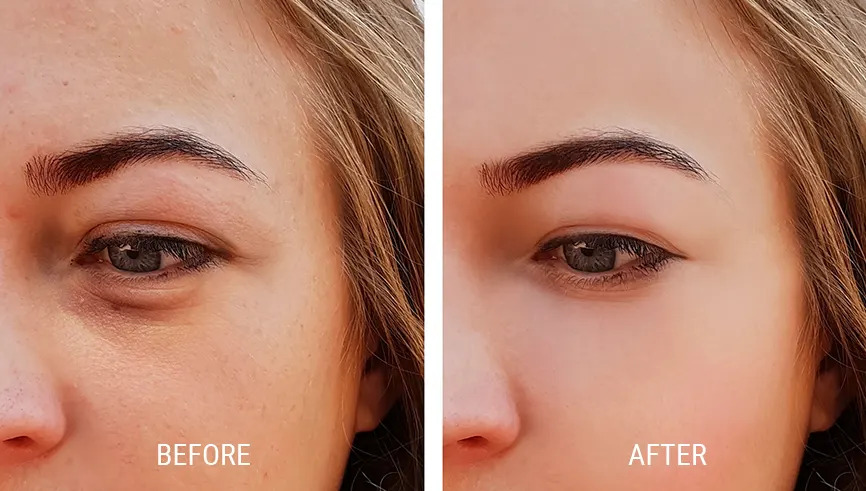
People tend to notice tired eyes before they notice anything else. In news photos, in video calls, in mirrors on the way out of the house, under-eye hollows and dark circles carry a lot of emotional weight. They are tied, fairly or not, to ideas about health, age and how much sleep someone is getting.
Many readers blame late nights, stress and screen time. Those things do matter. But the darker grooves and shadows beneath the eyes usually have more to do with anatomy and genetics than with last week’s sleep record. Creams, concealers and in-clinic treatments sit on top of this deeper structure. To understand what they can and cannot do, it helps to know what is happening under the skin.
The under-eye area, in simple terms
The skin under the eye is some of the thinnest on the body. In most adults it is less than half a millimetre thick. Under that fine skin lie several key structures.
There is a ring of muscle that helps you blink and squint. Under the muscle is a layer of fat that pads the cheek and lower eyelid. Deeper still is bone. Where the lower eyelid meets the upper cheek, the bone dips slightly. This groove is often called the tear trough.
When we are young, the fat and connective tissue around this groove are fairly even, so light falls smoothly across the area. As we age, several slow changes occur at once:
- The skin becomes thinner and less elastic.
- The fat pads in the mid-face can shrink and descend.
- The ligament that runs along the tear trough, attaching skin and muscle to bone, stays put while the tissues around it sag slightly.
These shifts make the natural groove more obvious. The area above the groove may look hollow, and the cheek just below can bulge or appear puffy. Even when the skin itself is not very dark, the hollow casts a shadow that reads as a dark circle.
Genetics plays a major role. Some people have a deeper tear trough or a more prominent lower eye socket from their teens. In others, their skin type and bone structure make the area more likely to show changes early.
What makes circles look darker
If you lift the skin under your eye gently and the darkness almost disappears, it is mainly shadow from a hollow. If the colour stays, it is more about pigment and blood vessels.
The main contributors are:
Pigmentation. In some skin types, especially medium to darker tones, the under-eye area can accumulate extra melanin. This gives a brownish or greyish cast. It may run in families or be linked to sun exposure or eczema and rubbing.
Visible blood vessels. Thin, pale skin allows the blue and purple tones of the blood vessels and underlying muscle to show through. This is one reason circles can look worse in certain lights or when the skin is dry.
Volume loss. Loss of fat and collagen, or a deeper natural tear trough, creates a dip that captures shadow. Studio lighting, phone flashes and overhead office lights all exaggerate this.
Often all three factors overlap. Two people can have similar sleep patterns and health, yet one will look more hollowed and shadowed simply because of their inherited structure.
The usual suspects: sleep, allergies and screens
Short sleep, allergies and hours at a laptop often get blamed for dark circles. They do not usually create the underlying hollows, but they can make them look sharper.
Sleep deprivation. Poor sleep can lead to fluid pooling around the eyes and a paler, duller skin tone. The puffiness just beneath a hollow can increase the contrast, so the groove appears deeper. Temporary widening of small blood vessels can also increase the bluish tint.
Allergies and rubbing. Hay fever and perennial allergies cause itch, rubbing and swelling. Repeated inflammation can stimulate pigment in some people, so the area looks more brown over time. Rubbing can also weaken fine blood vessels, leading to a slightly bruised appearance.
Screen time and eye strain. Staring at screens does not permanently hollow out the eye area, but it can lead to squinting, fewer full blinks and dry eyes. This can make the muscles around the eyes more tense and the area more tired-looking. Long indoor days may also mean less natural light and more overhead lighting, which highlights shadows.
These factors amplify what is already present. Addressing them, through better sleep habits, allergy control or rest breaks, can soften the appearance but rarely removes established hollows.
Why concealer and eye creams have limits
Most people reach for topical fixes first. Concealers, brightening pens and eye creams occupy large sections of pharmacy shelves. They do have their place, but there are reasons they hit a ceiling.
Concealer. A well-matched concealer can neutralise colour, especially blue or brown tones. It cannot change the anatomy. In fact, heavy or dry concealer can settle into the crease of a hollow, making it look deeper as the day goes on. A product that looks convincing in soft bathroom light may look obvious under direct sunlight or office strip lighting.
Eye creams. Many formulas promise to firm, brighten or reduce dark circles. In practice, most work as moisturisers with some added ingredients.
- Caffeine and similar compounds can temporarily reduce mild puffiness by constricting vessels.
- Ingredients like vitamin C and niacinamide may support pigment control and collagen over months.
- Retinoids can thicken the skin slightly and smooth fine lines, although they need cautious use near the eyes.
None of these can rebuild lost fat or change bone structure. Stronger prescription creams can help pigment in some cases, for instance in post-inflammatory darkening or melasma. Even then, the effect on genetically deep hollows is modest.
This explains why someone can invest in expensive creams and still feel they look tired. The products are working on the surface, while the main issue lies in volume and light reflection.
What happens in an in-clinic assessment
When people look beyond creams, they often arrive at a cosmetic clinic asking for a solution to dark circles or under-eye bags. A responsible practitioner will usually start by stepping back from the grooves themselves.
A typical assessment includes:
Medical history. Questions about general health, medications, allergies, sinus issues, eye problems and any previous cosmetic work. Conditions such as thyroid disease, anaemia or kidney issues can affect the eye area and overall safety.
Sleep and lifestyle. How much genuine rest a person gets, whether they work night shifts, and if allergies or nasal congestion are present. These details matter because they may be amplifying the appearance, or hint at issues that treatment will not address.
Examination of skin and structure. The practitioner looks at:
- Skin thickness, texture and pigmentation.
- The depth and shape of the tear trough.
- The presence of true fat herniation (bulging fat pads) versus hollowing.
- Asymmetries between the two sides.
- The position of the cheeks and mid-face.
They may examine the face from several angles, with and without smiling. Photographs are usually taken under standardised lighting, partly for records and partly to show realistic before and after comparisons later.
Discussion of expectations. This part can feel blunt, but it is important. The practitioner will normally ask what specifically bothers the person. Is it the colour, the hollow, the puffiness or the fine lines. They will then explain which elements can be improved, and which are likely to remain.
Clinics that focus on this area, such as Victoria Rose Aesthetics in Pickering, Ontario, tend to spend time on this sorting-out process. In their case the work is nurse-led in a single location, and under-eye concerns sit alongside other cosmetic injection services like neuromodulators, primarily Nuceiva.
Tear trough filler: what it is meant to do
One of the better known in-clinic options is tear trough filler. This involves placing a soft, gel-like substance, usually based on hyaluronic acid, under the skin near the tear trough. The goal is not to fill the whole under-eye, but to soften the transition between the lower eyelid and the cheek so that light reflects more evenly.
If chosen and placed carefully, filler can:
- Reduce the appearance of a distinct groove.
- Lighten shadowing caused by a hollow, since the dip is less sharp.
- Improve the tired look created by a strong contrast between puffy cheeks and sunken under-eyes.
- Provide a modest lifting effect in the mid-cheek, depending on where the product is placed.
Improvement is often more about how the face looks as a whole than about erasing one line. People sometimes notice they look less drawn, or that friends comment they seem more rested, rather than guessing a specific procedure.
The product cannot:
- Change the colour of pigmentation or very visible veins.
- Tighten loose, crepey skin in a dramatic way.
- Remove prominent eye bags caused by bulging fat pads.
- Replicate what surgery can achieve in cases of significant lower eyelid changes.
The effect is temporary. Hyaluronic acid fillers gradually break down over months to a couple of years, depending on the product, placement and individual metabolism.
Risks and why some people are not good candidates
The under-eye area is sensitive and close to important blood vessels and the eye itself. Responsible practitioners are careful about who they treat here, and how often.
They may decline to use under eye filler in several situations.
Very loose or crepey skin. If the skin is very thin and lax, adding filler underneath can lead to visible lumps or a swollen, waterlogged look. The product has nowhere to sit smoothly. Other treatments, such as skin tightening or resurfacing, might be discussed instead.
Significant eye bags. When the main issue is bulging fat, not hollowing, putting filler into the dip in front of the bag can sometimes disguise the step-off. In more marked cases it can simply make the whole area look swollen. Eyelid surgery may be a more suitable option, and some cosmetic injectors will refer people to an oculoplastic surgeon rather than attempt to cover the problem.
Very strong pigment. If deep brown or grey pigmentation is the primary concern, filler has limited impact. The darkness remains, now sitting over a slightly fuller contour. Treating pigment usually involves creams, sun protection and sometimes laser or chemical peels, which carry their own risks, especially for darker skin tones.
Unrealistic expectations. If someone wants a complete erasure of any sign of fatigue or ageing, or hopes to fix long-term sleep deprivation or health problems with a syringe, a cautious practitioner will often say no. They may suggest more conservative steps, or a pause to reflect before doing anything.
General health and safety. Certain autoimmune conditions, bleeding disorders, severe allergies or current infections around the eye area can make filler unsafe. Pregnant and breastfeeding women are typically advised to avoid elective cosmetic injections, though guidelines differ.
Even in suitable candidates, the procedure carries risks. These range from temporary issues, like bruising, swelling and tenderness, to serious complications if filler enters a blood vessel and affects circulation. Practitioners who work in this area should know the anatomy well, use conservative amounts and have protocols and dissolving agents on hand in case of problems.
The wider picture: tired eyes and tired people
Hollows and dark circles rarely exist in isolation. They intersect with how people feel about work, parenting, caring duties, illness or simple ageing. Someone who feels fine can be told often that they look exhausted. Someone who really is exhausted may fixate on their under-eyes as the most visible part of a much bigger strain.
Cosmetic treatments sit awkwardly in this space. They can offer a modest improvement in the mirror, but they cannot grant more sleep, safer housing, secure work or a fair division of care at home. A good consultation recognises this. Practitioners who ask about context are not prying, they are trying to understand whether their tools are suited to the problem in front of them.
Understanding the basic anatomy, and what each option genuinely does, can take some of the heat out of decisions. Under-eye hollows and dark circles are not a character flaw, nor a simple reflection of whether someone is living well. They are part inherited structure, part time and light. Creams, concealers and clinics can adjust how they appear, but the underlying story is written in bone, skin and the lives people are actually living.
