

Over the past decade, medical tourism for hair restoration has experienced exponential growth, with Turkey emerging as the world’s leading destination. Every year, tens of thousands of international patients travel to cities like Istanbul to reclaim their confidence and restore their hair. However, as the market expanded, a sharp divide opened up within the industry, creating two distinct clinical models: high-volume “hair factories” and doctor-led boutique practices.
For anyone considering a trip abroad for hair restoration, understanding the differences between these two operational styles is critical. Choosing the right clinic isn’t just a matter of price, it directly impacts your safety, procedural quality, and whether your final hairline looks completely natural or obviously artificial.
What Is a “Hair Factory”?
High-volume clinics, often referred to in the industry as “hair factories” or “hair mills,” operate on a scale-driven business model. These facilities treat dozens of patients per day, relying heavily on a revolving team of technicians to handle almost every stage of the procedure, from harvesting donor grafts to making scalp incisions and implanting hair.
Features of High-Volume Clinics:
- Technician-Led Procedures: A licensed doctor may only drop by for a brief greeting or to quickly draw a hairline, leaving the technical and surgical steps to technicians.
- Low Upfront Costs: By processing high patient numbers daily, these clinics can offer bottom-dollar prices.
- Aggressive Graft Harvesting: To market “maximum density,” these operations may over-harvest donor areas without considering long-term hair preservation or natural spacing.
While hair factories offer budget-friendly entry points, the lack of continuous medical oversight can increase the risk of uneven donor depletion, improper graft placement angles, and poor graft survival rates.
What Is a Boutique Hair Restoration Clinic?
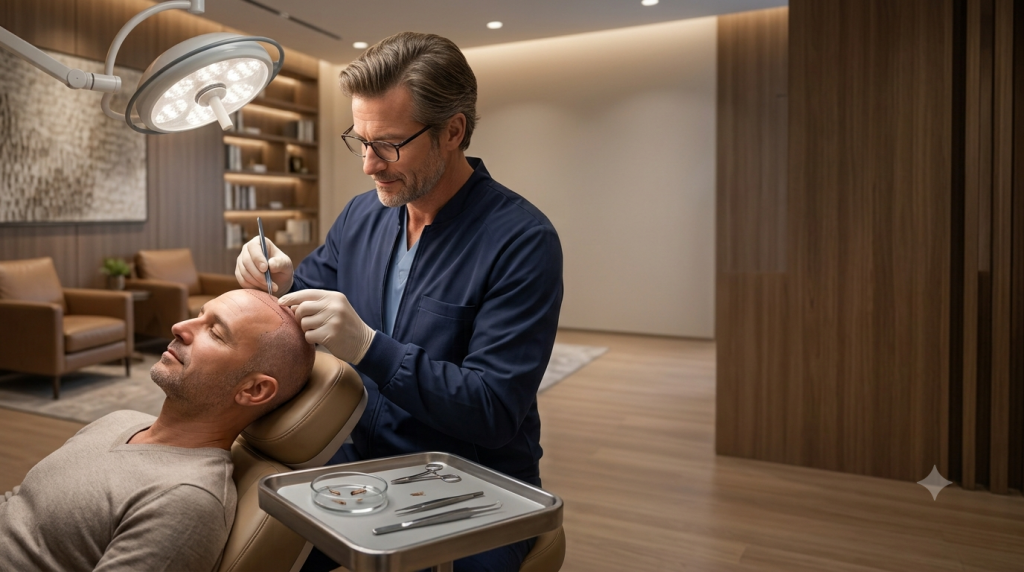
In contrast, boutique clinics prioritize medical quality over volume by capping daily patient intake, frequently to just one or two patients per day. In a boutique setup, the primary surgeon takes personal ownership of the entire procedure, performing critical surgical tasks directly rather than delegating them to assistants.
Key Advantages of Boutique Clinics:
- Direct Surgeon Involvement: A board-certified hair restoration specialist conducts the initial consultation, personally designs the hairline, creates the recipient channels, and oversees graft extraction.
- Artistic Precision: Hairline design requires meticulous aesthetic awareness. Boutique surgeons design hairlines with subtle micro-irregularities that mirror natural growth rather than rigid, geometric lines.
- Higher Graft Survival Rates: Capping daily procedures ensures that extracted grafts are handled gently and implanted quickly using advanced methods like Sapphire FUE or Direct Hair Implantation (DHI).
- Tailored Aftercare: Patients receive individualized post-operative instructions, custom recovery plans, and direct follow-up care from the surgical team.
A premier example of this approach is a specialized Dr Hakan Hair Transplant in Istanbul. With over two decades of surgical experience, Dr. Hakan Bozkurtoglu restricts his clinic to a maximum of two patients per day. This guarantees dedicated attention and adherence to his core philosophy, crafting organic, “no straight line” hairlines that seamlessly blend with a patient’s natural features.
Boutique vs. Factory: A Direct Comparison
| Feature | Hair Transplant “Factory” | Boutique Practice |
| Daily Patients | 10 to 30+ patients | 1 to 2 patients |
| Surgeon Role | Supervisory or minimal presence | Hands-on execution and direction |
| Hairline Design | Standardized, generic patterns | Customized based on facial anatomy |
| Graft Handling | Technician teams working rapidly | Specialized micro-FUE / DHI precision |
| Long-Term Focus | Immediate graft volume | Donor area preservation for future growth |
Key Questions to Ask Before Booking Your Surgery
To avoid accidentally booking a high-volume factory when you expect 1-on-1 specialist care, ask prospective clinics these key questions before making a financial commitment:
- Who will perform each step of my surgery? Ask specifically whether a licensed doctor or a technician will be making the incisions and extracting the donor grafts.
- How many patients does the clinic treat each day? If a clinic schedules dozens of surgeries simultaneously, individual doctor oversight is virtually impossible.
- What is the surgeon’s background and certification? Verify double-board certifications and years of dedicated experience in specialized hair restoration techniques.
- How does the clinic plan for donor area preservation? Ensure the surgeon has a strategy to preserve donor hair density in case future pattern baldness occurs.
How Healthcare Facilitators Can Help
Navigating international options and filtering out low-quality clinics can feel daunting for first-time medical travelers. This is where professional medical coordination services like Yapita Health simplify the decision-making process.
By connecting patients directly with accredited boutique clinics, verifying surgeon credentials, and organizing all-inclusive travel logistics including hotel stays, VIP transfers, and translation services, facilitators ensure patients receive safe, doctor-led medical care without operational stress.
Final Thoughts
Hair restoration is a permanent cosmetic procedure. While a cheap price tag from a high-volume “hair factory” may look attractive initially, repairing an over-harvested donor area or a poorly placed hairline is far more difficult and expensive than doing it right the first time.
By choosing a doctor-led boutique clinic that limits daily volume, you invest in artistic hairline design, surgical safety, and a natural outcome that lasts a lifetime.
