

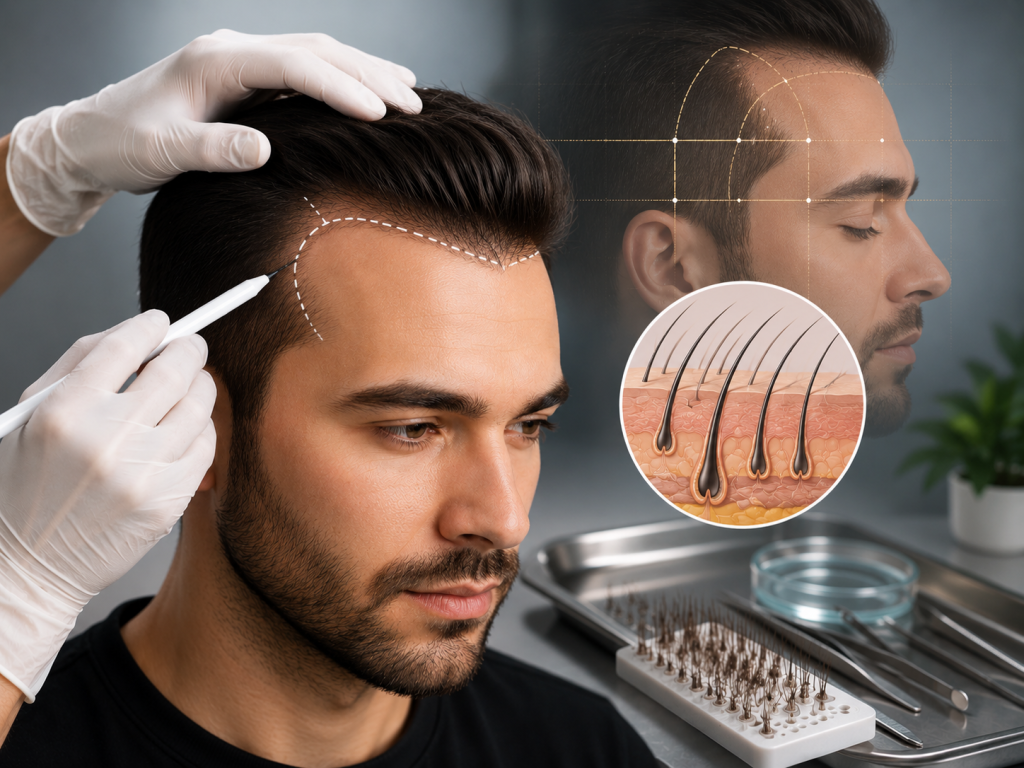
For decades, the mention of hair transplants conjured images of unnatural, plug-like rows that failed to mimic real human hair growth. Thankfully, the field of hair restoration has undergone a quiet revolution. Modern hair restoration is no longer just a medical procedure, it is a sophisticated interplay of surgical precision, dermatological science, and artistic geometry.
Today, the measure of a successful hair transplant isn’t simply how much hair is moved; it is whether anyone can tell a procedure took place. Achieving an undetectable, age-appropriate result relies heavily on how the new hairline is designed. Here is what science, aesthetics, and modern techniques teach us about crafting a truly natural hairline.
1. The Geometry of the Face: Respecting Facial Ratios
A natural hairline is never drawn at random. Aesthetic surgeons rely on classical design principles, such as Leonardo da Vinci’s Rule of Thirds, to determine the optimal placement of the hairline relative to facial proportions.
The human face is vertically divided into three equal segments:
- From the chin to the base of the nose.
- From the base of the nose to the eyebrow line (glabella).
- From the eyebrow line to the original hairline.
Lowering a hairline too far disrupts these proportion rules, creating a heavy, unnatural look that clashes with facial structure. Moreover, surgeons must consider the frontotemporal angles (where the frontal hairline meets the temples). Naturally aging men typically have slight recessions at the temples; completely filling these in creates an artificial, “doll-like” framing that ages poorly as time passes.
2. Micro-Irregularities: The Myth of the Straight Line
If you look closely at a natural, non-transplanted hairline in high-resolution detail, one feature becomes immediately obvious: there are no straight lines in nature.
A real hairline consists of micro-irregularities, subtle, macro- and micro-zigzags that break up the border between the forehead and the scalp. High-volume, assembly-line procedures often fail here by planting grafts in harsh, linear rows.
Master hair transplant surgeons spend considerable time meticulously placing individual grafts in soft, staggered arrangements. By introducing controlled micro-waves and varying the density along the front line, light reflects off the scalp naturally, softening the transition from bare skin to dense hair.
3. Graft Selection and Feathering
The human scalp naturally grows hair in follicular units, small, naturally occurring clusters of one to four hairs. How these varying cluster sizes are deployed makes all the difference in hairline creation.
- Single-Hair Grafts (The Transition Zone): The very front edge of the hairline often referred to as the “soft zone” or “feathering zone” consists exclusively of fine, single-hair grafts. Placing multi-hair grafts directly at the leading edge creates a harsh, unnatural wall of hair.
- Two- and Three-Hair Grafts (The Density Zone): Behind the single-hair transition zone (usually 0.5 to 1 cm deep), two-, three-, and four-hair grafts are packed closely together to build volume, depth, and coverage.
This gradual progression from light, single-hair feathering to dense multi-hair clusters creates a soft visual gradient that perfectly mimics natural growth.
4. Direction, Angling, and Elevation
Hair doesn’t grow straight up at a 90-degree angle; it emerges from the scalp at acute angles that change across different areas of the head.
At the frontal hairline, follicles typically exit the scalp at a sharp 10 to 15-degree forward angle. Furthermore, the direction of hair growth shifts as you move from the center of the forehead toward the temples, following natural swirl patterns and cowlicks.
Inserting grafts at the wrong angle, even with perfect single-hair placement results in hair that stands straight up, making it impossible to style naturally. Precision tools like micro-sapphire blades and implanter pens allow skilled surgeons to cut channels and insert grafts at the precise depth, elevation, and directional angle required for seamless styling.
5. Choosing the Right Expertise and Facilitation
Because hairline design demands both artistic talent and high-level medical discipline, selecting the right surgical team is paramount. Top-tier clinics prioritize individual customization over high-volume patient turnover.
Clinics like Long Hair Center, Istanbul specialize in doctor-led hairline design, combining advanced Sapphire FUE and Direct Hair Implantation (DHI) techniques to ensure high-density graft survival while maintaining facial harmony. Their focus on custom single-hair graft positioning ensures that every hairline is tailored to the patient’s age, bone structure, and future hair loss trajectory.
For international patients researching these options abroad, navigating clinic accreditation and travel logistics can feel daunting. Utilizing dedicated healthcare facilitators like Yapita Health helps streamline the process. Facilitators connect patients directly with verified specialists, assist with pre-surgical consultations, and manage end-to-end travel logistics, allowing patients to focus entirely on their aesthetic transformation.
Summary Checklist for a Natural Hairline
| Aesthetic Element | Standard/Outdated Method | Modern Science & Aesthetic Approach |
| Border Shape | Straight, rigid geometric lines | Micro-zigzag patterns with soft irregularities |
| Leading Edge | Multi-hair grafts planted at the front | Pure single-hair grafts in a 0.5cm transition zone |
| Implantation Angle | Steep or perpendicular (45°–90°) | Flat, acute angles (10°–15°) matching natural growth |
| Proportions | Lowered excessively regardless of age | Designed using facial thirds and temporal recession principles |
Final Thoughts
A great hair restoration procedure shouldn’t draw attention to itself, it should draw attention back to your face. By combining facial geometry, micro-grained graft distribution, natural angling, and doctor-led artistry, modern hair transplants deliver undetectable results that stand the test of time.
