

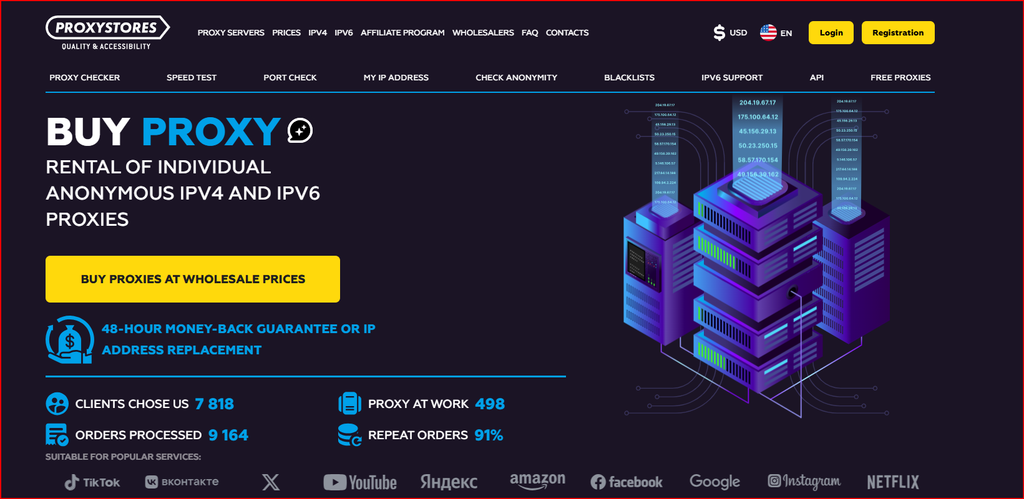
I reviewed ProxyStores through three different business scenarios rather than one generic score: regional e-commerce QA, social-media/browser-profile operations and public market research. Each workload needs a different balance of price, location consistency and IP exclusivity, which makes the catalogue easier to evaluate.
ProxyStores website screenshot used as visual context for this review.
Three real workloads, three different buying decisions
ProxyStores makes more sense when the review is organized around actual work rather than around the navigation menu. I evaluated the catalogue through three scenarios: an e-commerce team checking regional storefronts, a social-media operations team managing stable browser sessions, and a market-research team collecting public competitive data. Each workload values different things. E-commerce QA wants location consistency, social workflows care about stable identity, and research teams care about cost, concurrency and logging. The right proxy tier therefore changes by scenario.
Pricing and product map
The pricing snapshot below shows how the main fixed-proxy categories compare. Shared IPv4 is the low-cost choice, individual IPv4 increases exclusivity, IPv6 is extremely inexpensive for compatible destinations, and MTProto serves a specialized Telegram use case. As always, the live checkout can change by country, quantity, term and inventory, so these figures should be treated as a working snapshot rather than a permanent tariff sheet.
| Proxy type | 5 days | 30 days | 90 days | 360 days |
|---|---|---|---|---|
| IPv4 Shared | $0.67 | $0.99 | $2.97 | $11.88 |
| Individual IPv4 (1-20) | $0.96 | $1.77 | $5.31 | $21.24 |
| IPv6 /32 (1-99) | $0.10 | $0.51 | $1.53 | $6.12 |
| MTProto (1-20) | $0.96 | $1.77 | $5.31 | $21.24 |
I would verify the exact country stock and current order terms on the ProxyStores English site before assigning a budget to a larger deployment.
Scenario A: e-commerce storefront and checkout QA
An e-commerce team often needs to answer questions that are simple to describe but hard to verify from one office connection: does the correct currency appear, is the shipping banner localized, are regional products visible, does a coupon apply in the intended country, and does the checkout flow show the correct delivery options? A fixed proxy is useful because it creates a repeatable country-specific view. I would start with shared IPv4 for public storefront checks, then move critical checkout validation to individual IPv4 if shared-IP reputation creates inconsistent behavior.
The important discipline is to separate observation from transaction. Viewing product pages and regional pricing is lower risk than creating accounts or attempting purchases. For checkout QA, use test accounts, sandbox/payment-test methods where available, and respect the retailer’s policies. The proxy should be one component of a controlled QA plan, not a way to bypass restrictions.
Scenario B: social-media and browser-profile operations
Social-media work is more sensitive to continuity. Frequent IP changes, country changes or many profiles sharing one address can create friction. For that reason, individual IPv4 is the tier I would evaluate first. One proxy should be mapped to one profile or one clearly defined role, and the same location should remain consistent with the account’s normal operating pattern. Shared IPv4 can be cheaper, but the lower price is not valuable if the team spends time resolving repeated verification challenges.
I would also standardize browser configuration. The proxy protocol, DNS behavior, timezone, language and profile metadata should not contradict one another. ProxyStores can provide HTTP/SOCKS5 access, but the buyer is responsible for keeping the rest of the environment coherent. A proxy alone does not make multi-account operations reliable.
Scenario C: market research and public-data monitoring
Market research is where the cost profile becomes more interesting. If the job is read-only—checking public product availability, tracking public prices, comparing localized pages or monitoring search visibility—shared IPv4 may offer enough value at very low cost. For larger public-data workflows, I would focus on error logging and target compatibility before buying more addresses. A pool of 100 proxies does not improve a script that retries too aggressively or fails to respect target-site policies.
IPv6 can be a smart research tier when the target list supports it. The correct approach is to test a small allocation against the real destinations, not to assume modern websites all behave identically over IPv6. If several critical targets fail, the low unit price does not compensate for unusable coverage.
Use-case decision matrix
| Use case | Recommended starting tier | Why |
|---|---|---|
| Regional storefront QA | Shared IPv4 | Low-cost location consistency for public pages |
| Checkout / authenticated QA | Individual IPv4 | Cleaner identity and easier troubleshooting |
| Social browser profiles | Individual IPv4 | Stable one-profile / one-IP assignment |
| Public market research | Shared IPv4 | Cost-efficient for read-only regional checks |
| IPv6-compatible monitoring | IPv6 | Lowest cost when destination support is verified |
| Telegram-specific proxy use | MTProto | Protocol designed for the compatible Telegram workflow |
What I liked
- The catalogue gives buyers several cost/control levels rather than forcing one proxy type on every workflow.
- Short rental periods make it practical to validate a country before committing.
- HTTP and SOCKS5 compatibility works with common browsers, QA tools and automation clients.
- Utility tools such as proxy checking and anonymity checks support a repeatable setup routine.
- Pricing is easy to understand when the buyer first identifies whether exclusivity is actually required.
What could cause problems
- Shared-IP reputation is inherently less predictable than an individual address.
- Datacenter/fixed proxies do not replicate residential or mobile network characteristics.
- Cheap IPv6 capacity can be wasted if the destination list is not tested first.
- Social and account workflows require consistent browser and session practices beyond the proxy itself.
- Large-scale research needs rate limits and logs; extra proxy quantity is not a substitute for good automation design.
A practical first-week rollout plan
If I were adopting ProxyStores for a team, I would not buy a large pool on day one. On day one I would purchase one or two addresses in the most important country and validate the exact applications. On days two and three I would assign each working IP to one named use case and record the target websites, protocol and any errors. By the end of the week I would have enough evidence to decide whether shared IPv4 is reliable for the research tasks, whether social profiles need individual IPv4, and whether IPv6 actually reduces cost without reducing coverage. This staged rollout also makes the replacement process easier to evaluate while the order is still small. The goal is to turn proxy purchasing into an evidence-based capacity decision rather than a bulk purchase based on unit price alone.
For larger teams, I would add ownership and expiry fields to the proxy inventory, plus a simple rule that no address is reassigned to an unrelated account or campaign without a deliberate review. That small governance step prevents many of the confusing session and reputation problems that are often blamed on the proxy provider itself.
Final verdict
ProxyStores is a practical option when the buyer can translate the workload into a proxy requirement. I would use shared IPv4 for low-risk storefront and research checks, individual IPv4 for persistent sessions and social/browser profiles, IPv6 only after compatibility testing, and MTProto only for the specialized workflow it is designed to serve. The service is strongest as a flexible fixed-proxy supplier, not as an all-in-one managed scraping or residential-IP platform.
FAQ
Which ProxyStores tier is best for e-commerce QA?
Shared IPv4 is a sensible starting point for public storefront checks. Individual IPv4 is preferable for authenticated or persistent QA sessions.
Can ProxyStores work for social media?
Individual IPv4 can fit stable browser-profile workflows, but account policy compliance and consistent browser configuration remain essential.
Is shared IPv4 good for market research?
It can be cost-effective for read-only public research, especially when the workflow is tolerant of occasional reputation variance.
When should I use IPv6?
Use it only after confirming that the websites and applications in your project support IPv6 reliably.
Does a larger proxy pool automatically improve scraping?
No. Request behavior, logging, destination rules and software quality matter as much as the number of IPs.
Official site: ProxyStores official website
