

The useful question about SpaceProxy is not whether the service has a long feature list; it is whether inexpensive fixed proxies can stay practical across an ordinary workday. I mapped the product to localization, SEO checks, browser profiles, monitoring and light automation to see where the budget pricing makes sense and where exclusivity matters more.
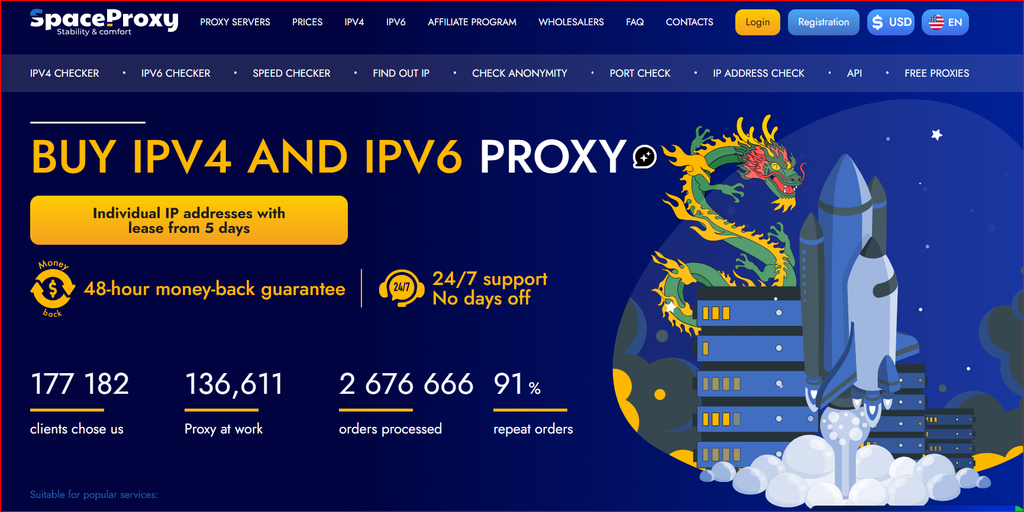
SpaceProxy website screenshot used as visual context for this review.
A normal business day with SpaceProxy
For this review I used a day-in-the-life structure rather than a feature checklist. The question is simple: can a budget fixed-proxy service be useful throughout a normal business day without becoming an operational burden? I mapped the published SpaceProxy catalogue to the work a small agency, SEO team, QA specialist or market-research operation might actually do from morning to evening. That means checking localized pages, validating campaigns, running browser profiles, testing endpoints and maintaining a small proxy inventory. I did not run an independent month-long uptime study or publish synthetic speed numbers; the emphasis here is workflow fit, plan economics and setup discipline.
08:30 – ordering and pre-flight checks
The first advantage of SpaceProxy is that the catalogue is easy to segment: shared IPv4 for low-cost tasks, individual IPv4 for exclusive use, IPv6 for compatible targets, and MTProto for narrower Telegram-related requirements. The provider also exposes tools such as proxy checking, speed checks, anonymity checks, port checks and IP lookup. Those tools matter most at the beginning of the day because a team should validate a new endpoint before assigning it to a real campaign.
| My pre-flight rule: Check the IP, country, protocol and target-site compatibility before logging in to a dashboard or launching an automated job. |
Pricing: why the five-day option matters
A short rental window is useful for buyers who want evidence before committing. SpaceProxy has historically published five-day, 30-day, 90-day and 360-day periods across several proxy categories. That lets a team test one country or use case without locking into a long term. As with any proxy service, final pricing depends on the exact product, quantity, country and live inventory, so the checkout page should be considered authoritative.
| Proxy type | 5 days | 30 days | 90 days | 360 days |
|---|---|---|---|---|
| IPv4 Shared | $0.67 | $0.99 | $2.97 | $11.88 |
| Individual IPv4 (1-20) | $0.96 | $1.77 | $5.31 | $21.24 |
| IPv6 /32 (1-99) | $0.10 | $0.51 | $1.53 | $6.12 |
| MTProto (1-20) | $0.96 | $1.77 | $5.31 | $21.24 |
Before ordering, I would compare the live country inventory and rental terms on the SpaceProxy English website because stock and promotions can change.
10:00 – local SEO and localization checks
For localized SERP checks, regional landing-page QA and language verification, a shared IPv4 address can be enough because the work is mostly read-only. I would keep one clean reference proxy per country and compare results with a normal direct connection. The value of a fixed proxy here is consistency: if the same IP is used across repeated checks, differences are easier to attribute to the destination site rather than constant rotation.
The low price becomes useful when the team needs several regions at once. Instead of buying expensive capacity everywhere, I would select only the countries that map to active campaigns and expand after the workflow proves useful. For destinations where shared-IP reputation creates noisy results, switching that specific market to individual IPv4 is a more rational upgrade than replacing the entire pool.
12:30 – browser profiles and authenticated tools
At midday the use case changes. Logging into analytics, commerce, advertising or social dashboards adds session risk, so I would move away from shared addresses. Individual IPv4 is easier to reason about because the IP is not simultaneously being used by unrelated customers during the rental period. That does not guarantee an account platform will accept every login, but it reduces one source of unpredictability. I would pair each proxy with one profile, record the assigned country and avoid switching locations mid-session.
15:00 – data collection and monitoring
For data collection, I care more about observability than headline concurrency. A business workflow should record which IP made a request, what target was contacted, how long the response took and whether a failure repeated on a control route. This makes it possible to separate proxy failures from destination throttling or application errors. SpaceProxy can provide the network layer, but the buyer still needs sensible request rates, retry rules and compliance with target-site policies.
IPv6 deserves special attention here. It can be extremely cost-effective for compatible destinations, but it should not be purchased in bulk simply because the price is low. I would run a destination matrix first: green for full IPv6 support, amber for partial support and red for IPv4-only. That single check can prevent a cheap purchase from becoming wasted inventory.
17:30 – inventory review and renewal decisions
At the end of the day, the proxy inventory should be treated like any other technical asset. I would mark each address as active, problem, replacement requested or retired; record the expiry date; and note which team member or application owns it. Five-day rentals are great for experiments, but once a workflow proves stable, a longer term reduces administrative overhead. The decision to renew should be based on actual task success, not simply whether the proxy responds to a ping or checker.
What works well for daily business use
- Very low entry cost for testing several regions or use cases.
- Short rental periods reduce commitment when a project is temporary or experimental.
- Shared and individual IPv4 tiers make it possible to trade cost against exclusivity.
- Built-in checker utilities fit well with a repeatable pre-flight routine.
- IPv6 pricing is attractive when the destination list is confirmed compatible.
Where I would be careful
- A fixed datacenter-style proxy is not the same product as a residential or mobile proxy.
- Shared IPv4 reputation can vary because the address is not exclusive.
- IPv6 compatibility must be checked target by target.
- Long rental terms should be purchased only after a country and workflow have been validated.
- Business automation still needs rate controls, logs and a clear replacement process.
Verdict: affordable can be good enough when the workflow is disciplined
SpaceProxy is easiest to recommend as a low-cost fixed-proxy toolkit for teams that know what they need. It is well suited to localization QA, SEO checks, monitoring, browser profiles and controlled automation where the buyer can start small and validate each country. The service becomes less attractive when the requirement is specifically residential/mobile identity or a managed data-collection platform. For ordinary business tasks, however, the combination of cheap trials, multiple proxy classes and familiar protocols can be enough—provided the team manages the proxies as infrastructure rather than disposable credentials.
FAQ
Is SpaceProxy suitable for daily business use?
Yes for many fixed-proxy tasks such as localization checks, monitoring, browser profiles and controlled automation. The key is matching the proxy class to the task.
Why choose individual IPv4 over shared IPv4?
Individual IPv4 provides a cleaner exclusivity model and is easier to troubleshoot for persistent sessions or authenticated tools.
Is IPv6 the best value?
It can be, but only when the destinations and applications you use support IPv6 correctly.
How should I test SpaceProxy before a larger purchase?
Start with one or a few short-term proxies, verify the exit location and target compatibility, then scale only after logging successful results.
What is the main limitation?
These are fixed proxies rather than residential/mobile identities, so buyers needing ISP or cellular characteristics should evaluate a different proxy class.
Official site: SpaceProxy official website
